Affiliate disclosure: This post contains affiliate links. If you buy through them, we may earn a small commission at no extra cost to you.
Every kitchen has one: the spice cabinet where jars stand three rows deep, the paprika hides behind two ancient bottles of "mystery red powder," and cooking dinner starts with an archaeology dig. The good news? Spices are one of the fastest organizing wins in the whole house. The collection is small, the containers are uniform, and the payoff — grabbing what you need in two seconds, mid-recipe — lands every single day. Here's the full system, doable in an afternoon.
Step 1: Pull everything out and check the dates
Empty the cabinet, the drawer, the rack by the stove — all of it — onto the counter. Ground spices lose most of their punch after two to three years; whole spices last closer to four. If a jar has no date, open it and smell: if it smells like dust instead of dinner, it goes. Combine duplicates while you're at it. Most people discover they own three half-used jars of cinnamon and zero of the thing they actually needed.
Step 2: Decant into matching jars
This is the step that transforms the space. Mismatched store packaging wastes inches in every direction; uniform jars stack, line up and label cleanly. A set of glass spice jars with airtight lids — usually 4 oz, sold in packs of 24 or 36 — swallows the whole collection. Shop on Amazon → Add a small collapsible funnel to make transferring seeds and powders spill-free. Shop on Amazon →
Two tips before you pour: work over a tray, and decant one spice at a time — a counter dusted in five different powders is nobody's afternoon.
Step 3: Label so anyone can cook
Handwritten tape works, but pre-printed spice labels look clean and cover essentially every spice you'll ever own, often with blanks for the unusual ones. Shop on Amazon → Label the lid as well as the side — if your spices live in a drawer, the lid is all you'll see. Add a small "opened" date on the bottom so the next purge takes minutes, not guesswork.
Step 4: Pick the storage that fits your kitchen
There's no single right home for spices — there's the right one for your layout:
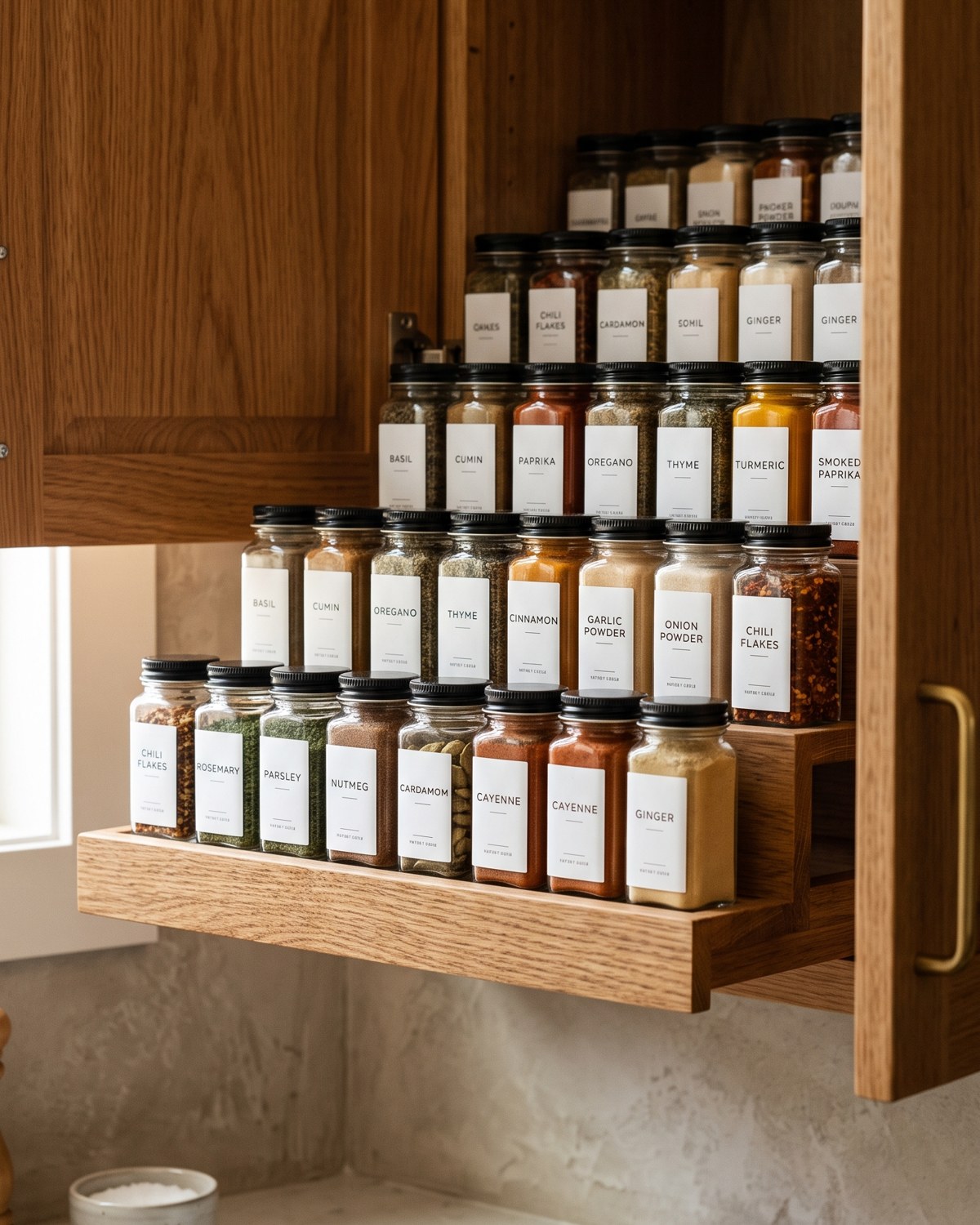
Cabinet people: a tiered shelf riser turns three hidden rows into a little amphitheater where every label faces you. Shop on Amazon → Drawer people: an in-drawer spice tray lays jars at an angle so labels read at a glance — the most satisfying option if you can spare the drawer. Shop on Amazon → No-space people: a slim rolling cart or door-mounted rack puts the collection on a wall or cabinet door instead of the counter. Shop on Amazon →
Whichever you choose, keep spices away from the stove itself — heat and steam are exactly what ages them fastest. A cool cabinet one step from the cooking zone is the sweet spot.
Step 5: Order them so your hands learn the layout
Alphabetical order photographs beautifully, but frequency order cooks better: your ten most-used spices in the front row or the closest drawer slot, baking spices grouped together, and the once-a-year specialty jars in the back. Within a week your hand goes to the cumin without your eyes helping.
The two-minute refill habit
Keep backstock — the big bags of refill spices — in one labeled bin on a high shelf, not mixed in with the jars. When a jar runs low, refill it from the bin during dinner prep. The display stays tidy, the system stays honest, and you'll never buy a fourth jar of cinnamon again.
A spice collection is small enough to finish in one afternoon and visible enough to enjoy every night. It's the rare organizing project that pays you back at 6 p.m. daily — start there this weekend.