Affiliate disclosure: This post contains affiliate links. If you buy through them, we may earn a small commission at no extra cost to you.
Handbags are the awkward guests of the closet: too structured to fold, too soft to stack, too nice to shove in a bin. So they end up in a slumped pile on the closet floor, hanging six-deep on a single hook, or migrating to chairs around the house. The result is always the same — you use the one bag on top and forget the rest exist. Here's how to store them so every bag keeps its shape, stays visible, and actually gets carried.
Step 1: Gather every bag and edit the collection
Collect every handbag, tote, clutch, and crossbody from around the house — closet floor, door hooks, the car, the entryway. Line them up where you can see them all. Then be honest: which bags have you carried in the past year? A bag with a broken strap you keep meaning to fix, the freebie tote pile, the purse that never sat right on your shoulder — those leave. Donate what's in good condition. Most people find they carry three or four bags and store fifteen.
Step 2: Sort by how often you carry them
Split what's left into three groups: the everyday rotation (the two or three bags you actually switch between), occasion bags (evening clutches, the wedding-guest bag), and seasonal bags (straw totes in winter, wool in summer). The everyday rotation earns the prime real estate at eye level. Occasion and seasonal bags can live on the high shelf — they just need to be protected and findable.
Step 3: Give the everyday bags a visible home
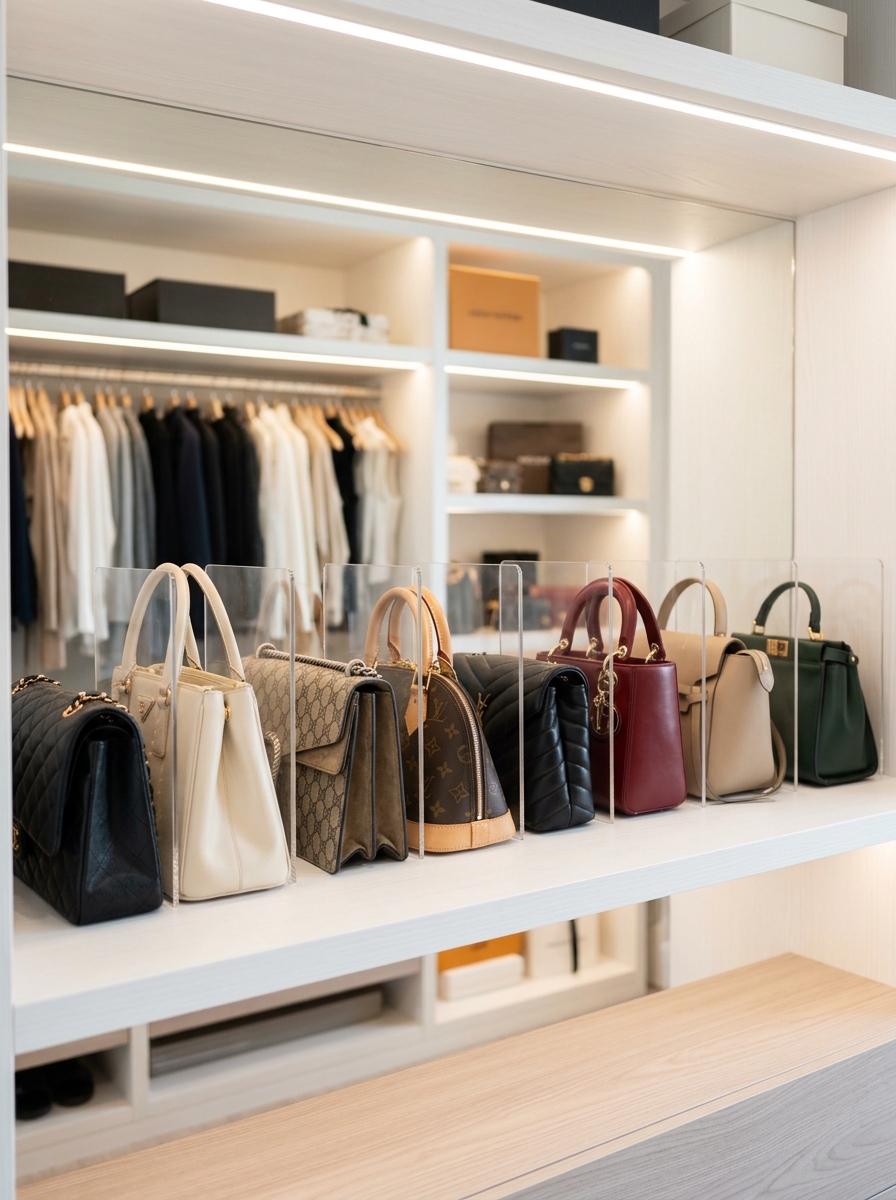
The bags you carry weekly should be as easy to grab as a coat. On a closet shelf, stand them upright and use shelf dividers so they don't slump into each other — one bag per slot, handles up. Shop on Amazon → If shelf space is tight, a hanging purse organizer on the rod turns one hanger's width into six or eight clear pockets, so every bag is visible at a glance. Shop on Amazon → Short on rod space too? An over-the-door organizer with large pockets swallows crossbodies and clutches on the back of the closet door. Shop on Amazon →
Step 4: Help structured bags keep their shape
A leather bag stored empty and slumped develops creases that never come out. Stuff structured bags with a purse pillow or simply with acid-free paper so they hold their shape between uses. Shop on Amazon → Never hang a heavy leather bag by its straps long-term — the weight stretches them; shelves or cubbies are kinder. Chain-strap bags should have the chain tucked inside so it doesn't scratch the leather.
Step 5: Protect the bags you store away
Occasion and seasonal bags do best on a high shelf, stuffed to hold their shape and slipped into dust bags — the cloth ones your bags came with, or a bought set. Shop on Amazon → If you prefer to see them, clear stackable bins with handles keep dust off while keeping the bags visible, and the handle means the top shelf is still reachable. Shop on Amazon → One bin per category — clutches together, straw bags together — and a label so future-you doesn't have to dig.
Keep the system going
The pile on the closet floor comes back one dropped bag at a time, so give the daily bag a landing spot — a hook by the door or the front slot on the shelf — and switch bags on the shelf, not on the bed. When a new bag comes in, one goes out; the divider slots set the limit, and when they're full, that's the collection.
Start with the edit — it's the step that makes all the others easy. Fifteen minutes of honest sorting, and suddenly the shelf you thought was too small holds every bag you actually love.